AI where it counts
We point AI at the work that actually eats your time.
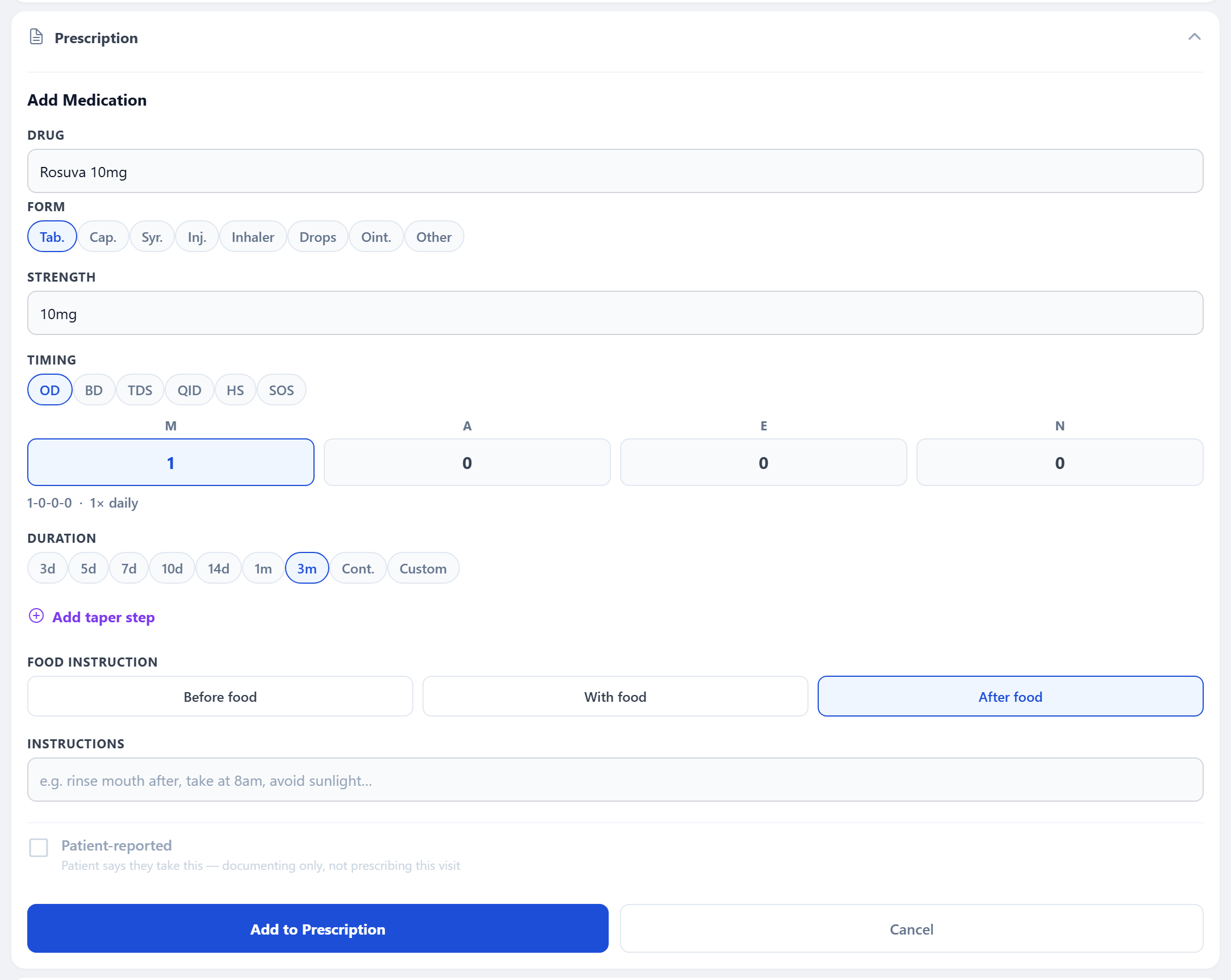
Prescribing is fast by design - protocols, favourites, dose chips and one-tap repeat, with native Indian-English dictation when you'd rather talk than type. Where AI earns its place is the surrounding work: it reads your paper lab reports (photograph → every value extracted, abnormals flagged, trends charted across visits), screens every prescription against the patient's whole care team, and learns your patterns so common prescriptions rise to the top. That deliberate focus is also why we're careful about the one feature competitors tout loudest - the ambient voice "scribe" - which bites hardest in a real Indian OPD:
Medico-legal risk
You sign off on a note a machine guessed at - scribes have been caught documenting entire exams that never happened.3
The time-savings fallacy
In the largest studies the savings are modest and inconsistent - not the magic the demos promise.4
Proof-reading overhead
AI notes are wordier, miss details and hallucinate - so you read and correct every one.2
Accents & "Hinglish"
Most consultations aren't in textbook English. Speech-recognition errors jump 30–50% on the accented, code-switched speech of a real visit.78
Regional languages
Even the best models miss 1 in 5 to 1 in 3 words in Indian languages - far more in Tamil, Telugu and Kannada - with patients the hardest to transcribe.56
Privacy & consent
An ambient scribe records the whole consultation and sends the audio to a third-party model. Patients are already suing over recordings made without consent,9 and recording a clinical conversation is itself regulated.10
Rxcript's AI works where clinical accuracy matters most: lab data (photograph → extracted values, flagged abnormals, visit-over-visit trends), drug interaction screening across every prescriber on the patient's care team, and adaptive ranking that learns your patterns. For transcription, prescribing is fast through structure - protocols, favourites, one-tap repeat: deterministic, with no transcript to police. The day an AI scribe is accurate enough for an Indian clinic, we'll add it - we just won't trade your medico-legal safety for a demo-friendly feature before then.