The prescribing tool for care that continues

It feels like your pad
only it never forgets a patient.

Write a prescription in seconds and hand the patient something professional - then find their whole history, lab trends and past dose changes waiting for you next time. Independent of pharma, with none of the hospital-system complexity.

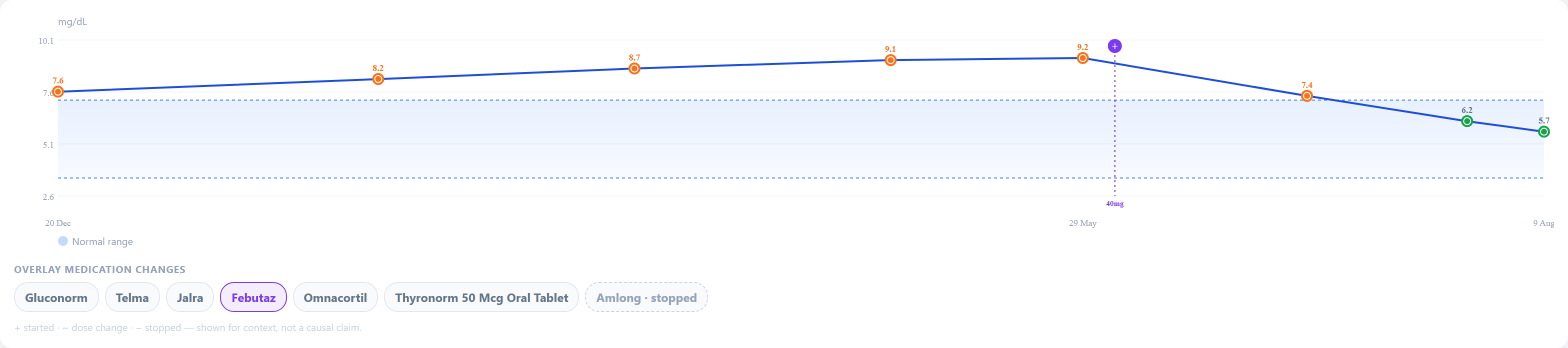
Blood Pressure - treatment response
target ~ + mmHg Ramipril ↑ Amlodipine +
Lab / vital trend with your medication changes overlaid - + started · ~ dose change · stopped.
Titration & treatment response

Titration you can see - your dose changes and the lab, on one timeline.

Chronic care is a series of adjustments. Rxcript plots a patient's lab or vital trend - creatinine, eGFR, HbA1c, blood pressure, weight - and marks exactly when you started, changed, or stopped each medicine on the same axis. Titrate an ACE-inhibitor and watch the blood pressure alongside it; adjust a diuretic and see the weight - across every visit, at a glance.

  • Overlay any medicine's start / dose-change / stop on a lab or vital trend
  • Built for titration - BP, HbA1c, LDL, creatinine, weight
  • Write step-down and tapering schedules - e.g. 40 → 20 → 10 → stop - and they print in full on the prescription
  • Cause and effect side by side - you draw the clinical inference
Treatment response, first

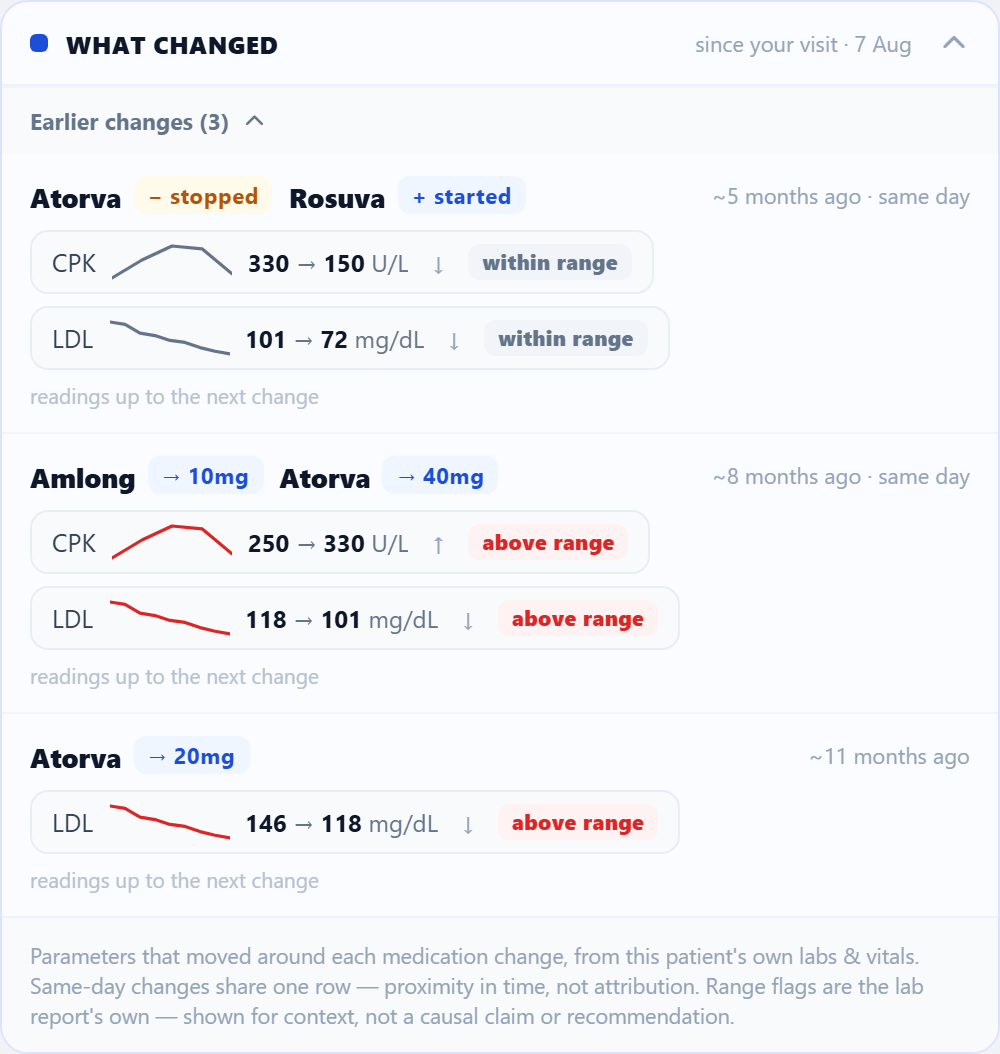
Every visit opens with what changed.

Before you've asked a question, Rxcript has already read the interval: the medicines you started, adjusted or stopped last time - and the labs and vitals that moved after each change, from the patient's own reports. The follow-up starts from evidence, not from memory or a hunt through old pages.

  • Anchored to your last visit - "since your visit · 12 Mar"; older changes fold away
  • Biggest movers first - BP, HbA1c, creatinine, weight - with each lab report's own range flags
  • Changes made the same day are grouped honestly together - the panel shows chronology, you draw the inference
  • Shown for context, never a causal claim - the clinical call stays yours
What changed - since your visit · 12 Mar
Telma→ 80mg Gluconorm→ 1000mg ~4 months ago
Blood pressure158/96 → 140/86 HbA1c8.6 → 7.4 %above range Serum creatinine1.05 → 1.25near range top
Parameters that moved after each medication change, from the patient's own labs & vitals - shown for context, not a causal claim.
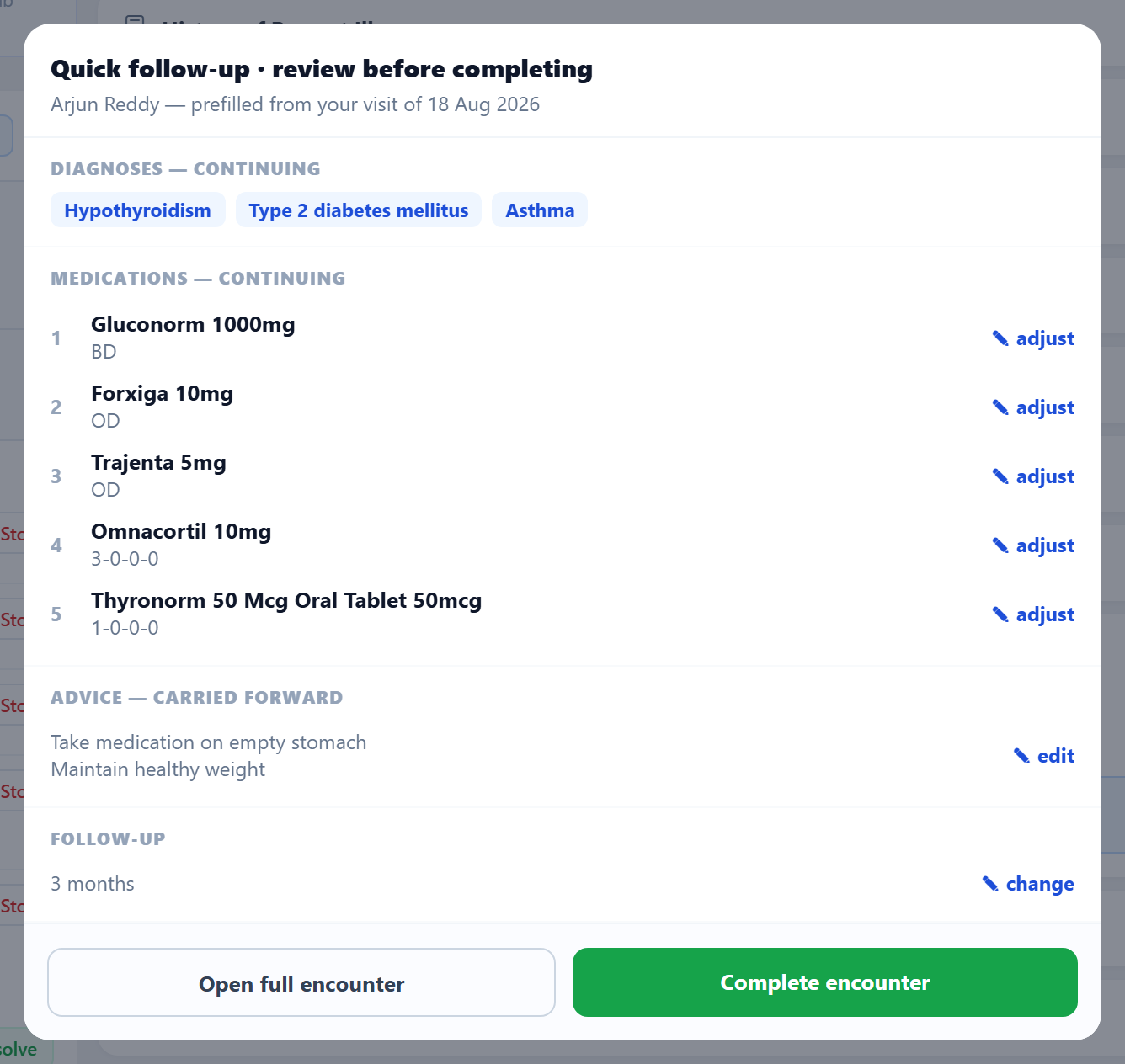
Quick follow-up · review before completing
DIAGNOSES - CONTINUING
Type 2 DiabetesHypertensionDyslipidaemia
MEDICATIONS - AS LAST VISIT
1Telma 801-0-0 · 90 days✎ adjust
2Gluconorm 10001-0-1 · after food✎ adjust
3Atorva 200-0-1 · HS✎ adjust
FOLLOW-UP 3 months → 12 Oct
Open full encounter Complete encounter
The routine visit, in three taps

A stable follow-up is a glance and three taps.

Open the visit - what changed is already on screen. Tap quick follow-up: continuing diagnoses, medicines, advice and the follow-up interval carry forward onto one review card laid out like the printed prescription. Review, complete, print. The ten-minute routine renewal becomes under a minute - and the record it writes is as complete as a full encounter.

  • Every line on the card is an edit handle back into the full form - adjust one dose and you're back
  • Last visit's investigations offered as tap-to-repeat chips
  • Offered only for patients you've seen before - a first visit always gets the full encounter
Write it in seconds

Type the brand, tap the dose, done.

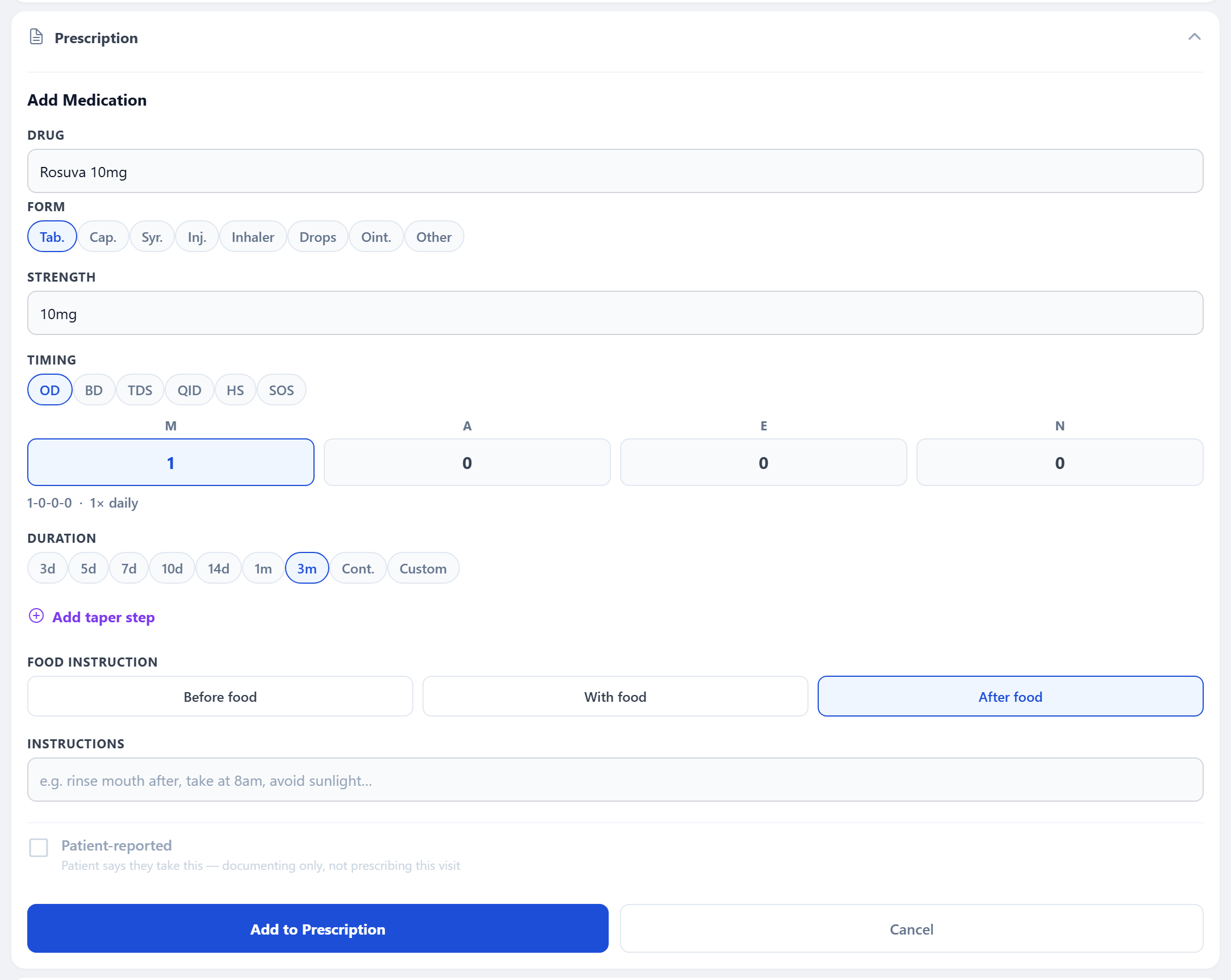
Start typing the brand you already write - Rxcript fills in the strength and form. Tap a dosing chip (OD, BD, TDS, 1-0-1), add a food instruction, and move on. The medicines you write every day are one tap away as favourites and protocols.

  • Brand or molecule search across India's medicines
  • Dose chips & MANE notation - no typing out instructions
  • Favourites and diagnosis protocols for repeat prescriptions
Add medication
augmentin |
Augmentin 625 (Amoxicillin + Clavulanate)
625mg · Tab.
ODBDTDS1-0-1After food
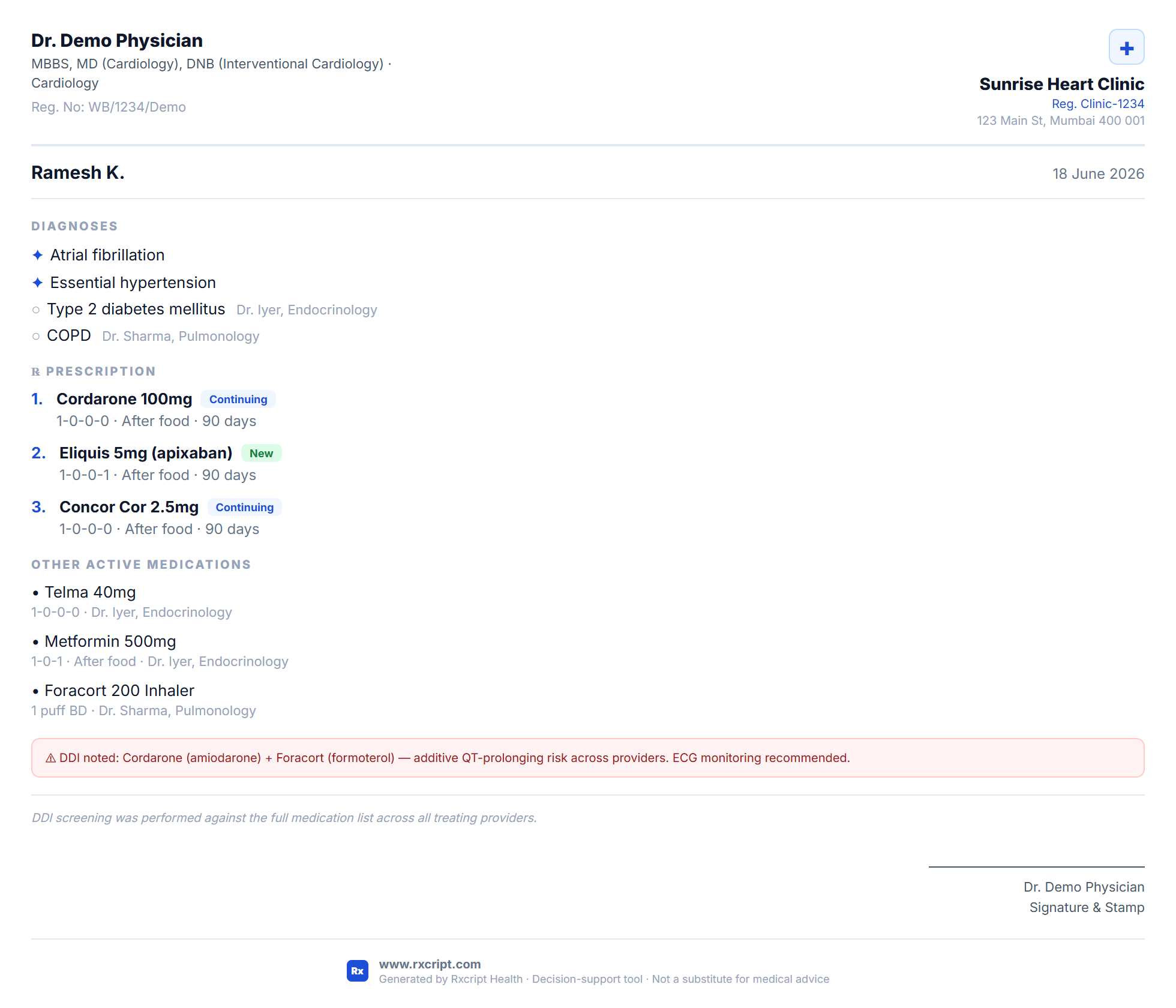
Rxcript printed prescription
Looks the part

A prescription that reflects your practice.

Clean, legible, and carrying your clinic's name - print it or send it to the patient by link or WhatsApp. Pharmacists stop calling to ask what you wrote, and patients keep a copy they won't lose.

  • Clinic-branded print & PDF output
  • Share to the patient digitally - no lost chits
  • Consistent, legible formatting every time
Never dig through files

Every patient, every visit - in one tap.

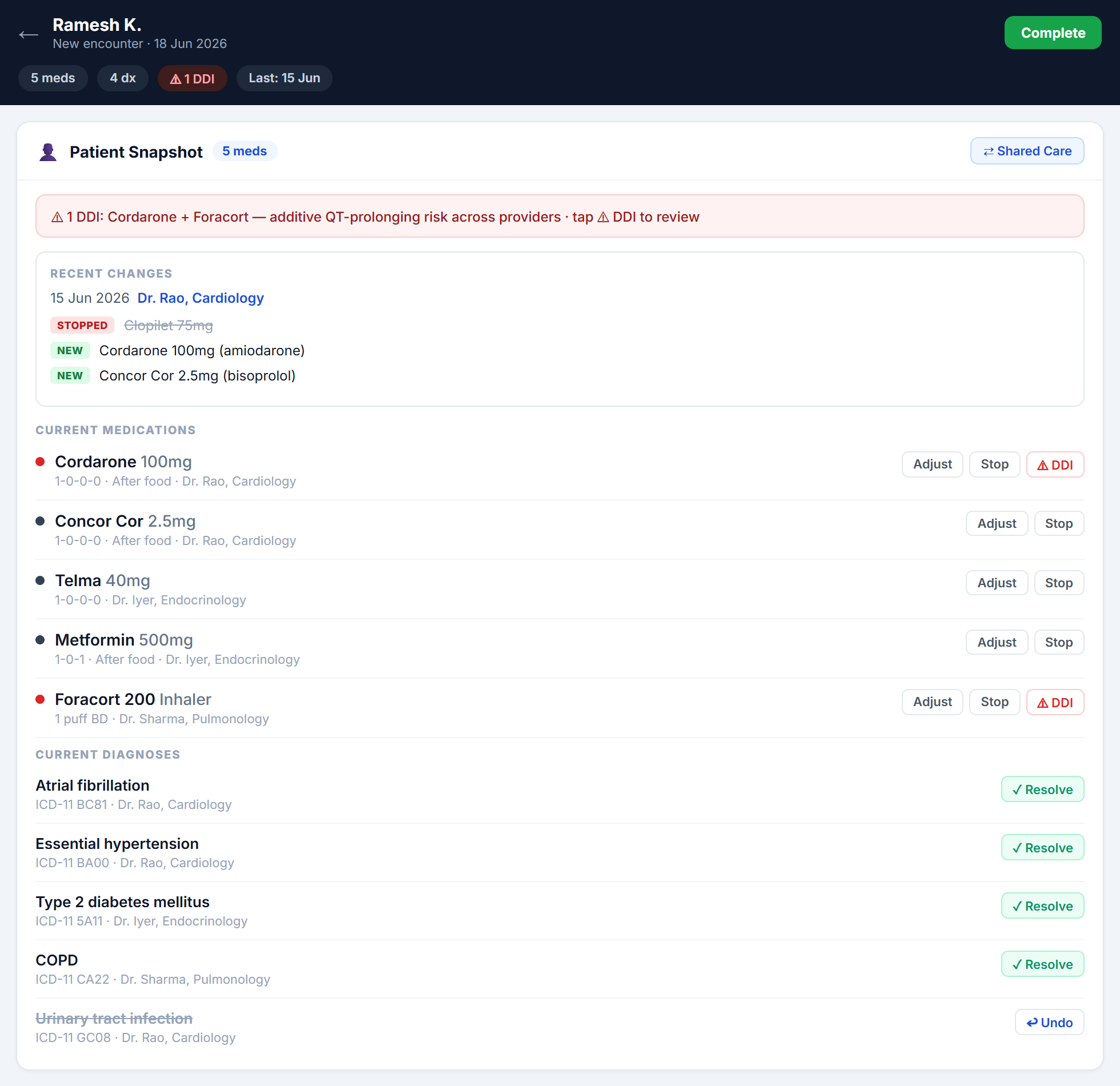
Search a returning patient by name or phone and their whole history is there: past prescriptions, diagnoses, and any labs. Reissue last time's prescription, adjust a dose inline, or start fresh - in seconds.

  • Instant patient lookup; walk-in or registered
  • One-tap repeat prescription; inline adjust/stop
  • Follow-up dates and lab reports in the same view
Rxcript patient snapshot
Independent by design

The only agenda on your screen is your patient's.

Rxcript takes nothing from pharma - so nothing on your screen is paid to be there. It's not a slogan; it changes what you see and trust every time you prescribe.

🧼

A clean clinical workspace

No pop-ups, no "suggested" brand-names nudged into your prescription to please a sponsor. What's on screen is what you chose to write - nothing paid to be there.

📖

Guidance you can trust

Interaction and safety alerts are drawn from peer-reviewed clinical evidence, not sponsored formularies. The medicine that surfaces first is the one you favourited - not the one someone paid to show.

🔒

Your patients aren't the product

We sell nothing about your patients - no phone numbers to diagnostic labs, no prescribing data to brands. Your records stay encrypted, yours, and exportable.

Shared care, private networks

Your referral network stays yours.

When a patient sees more than one doctor on Rxcript, every treating doctor sees the full clinical picture - all medicines and diagnoses - so safety checks always run across the complete list. Who sees whose name is a separate, deliberate choice.

🛡️

The full picture, for safety

Interaction checks run across everything the patient takes - including medicines prescribed by doctors you've never met. Clinical data is never held back where safety is concerned.

🤝

Names shared by consent only

Only doctors who have mutually enabled shared care for a patient see each other's names and specialties on prescriptions and diagnoses. Everyone else sees the medicine - not who prescribed it.

🚫

No marketplace, no poaching

Rxcript never advertises other doctors to your patients, never ranks you against colleagues, and never sells your prescribing patterns. The patients you built your practice on stay yours.

For clinics

One clinic. One prescribing standard.

Your preferred medicines - including the local brands you trust - and your clinic protocols are ready for every doctor from day one; patients book online from your clinic's public page, and your front desk books, reschedules and reassigns appointments and queues the day. Keep your billing tools; Rxcript is the clinical layer that makes the whole clinic prescribe like your best doctor.

Your brands, first

The brands your clinic trusts surface first in every doctor's search.

Your protocols, everywhere

Build a regimen once; every doctor applies it in one tap.

🧑‍⚕️

Online booking & front desk

Patients book online from your clinic's public page; staff book, reschedule, reassign and queue the day; every doctor sees the same history.

For your patients

A companion for the patient - nothing to install.

Your patients get a simple companion view of the care you provide - no app store, no download. They can keep their record current between visits, so the work of the next encounter is already done when they walk in.

❤️

Record vitals between visits

Patients log their own blood pressure, weight and sugar at home; the readings join the same trend you review at the next visit.

📸

Add a medicine from a photo

A patient can photograph a strip or box to add a medicine they're taking - flagged as patient-reported, so your clinical list stays clean.

🧪

Upload their own labs

Patients upload lab reports as they get them - Rxcript reads and trends the values, ready for you to review at the next encounter, or before if you want to check ahead.

📄

A summary they can carry

One tap prints a clean, branded health summary - three months of labs and vitals, trend-flagged - for the patient to carry to any doctor, including ones not on Rxcript. Your practice looks professional even in someone else's clinic.

Smart, not complicated

Quietly intelligent - so you tap less.

Rxcript stays simple on the surface. Underneath, it learns how you prescribe, already speaks your specialty, keeps your regimens a tap away, checks every prescription for you, and even reads your patients' lab reports - all to cut the typing, never add to it.

It learns how you prescribe

The more you use it, the faster it gets. Your most-used diagnoses, complaints and medicines rise to the top automatically - so your common prescriptions become a tap, not a search.

🩺

It speaks your specialty

Not one blind form for every doctor - your complaints, diagnoses and advice shortcuts come pre-loaded for your specialty, so a cardiologist and a nephrologist start with different, relevant suggestions - one form that adapts to your specialty, not a separate template you switch into.

🎙️

Dictate, don't type

Speak your complaints, history, examination and advice; Rxcript turns your voice into a structured text draft you review, edit and confirm with one tap before it goes on the prescription - so nothing lands unchecked. Your hands stay on the patient, not the keyboard.

Your regimens & medicines, one tap

Build a protocol once and apply the whole encounter - diagnosis, drugs, dosing, labs, advice - in a single tap. Favourite the brands you prescribe and they surface first. Share protocols clinic-wide.

🧪

Snap a lab - it reads it

Photograph or upload a lab report; Rxcript pulls out the values, flags what's abnormal, and charts the trend across visits - no LIMS, no lab-system integration, no manual entry. Just a photo of the paper report the way it actually reaches you.

🛡️

Active clinical safety

As each drug is added, Rxcript checks against a clinical evidence database and classifies every alert by mechanism (pharmacokinetic vs pharmacodynamic) and severity (minor / moderate / major). Checks run across the patient's complete medication list - including drugs prescribed by other doctors - and therapeutic duplication is flagged separately.

Everything in the box

The full toolkit

Fast prescribing

Brand search, dose chips, favourites, protocols, and a configurable encounter layout that fits how you work.

📄

Print, PDF & WhatsApp

Clinic-branded prescriptions, ready to print or send straight to the patient on WhatsApp - with their complete medicine list.

🗂️

Patient records

Visits, diagnoses, medicines and labs saved per patient. Walk-in and registered patients both supported.

🩺

Diagnosis & labs

Quick diagnosis search and lab-report capture, surfaced beside the patient's medicines when you need them.

🏥

Clinic & staff

Add multiple doctors and front-desk staff; shared patient records across your practice.

🛡️

Active interaction safety

Real-time DDI alerts as you prescribe - classified by mechanism and severity, checked across every doctor's medications for that patient. Therapeutic duplication detected separately.

Common questions

How Rxcript compares

Is Rxcript just a digital prescription pad?

No - and that framing undersells it significantly. Every patient builds a complete clinical record across every visit: prescriptions, active diagnoses, medication history, and lab-report trends. If a patient sees two specialists who both use Rxcript, both doctors see the other's medications and diagnoses - and every prescription is checked for dangerous interactions across the complete multi-specialist list, not just what is being written today. Think of it as a clinical record that grows by the act of prescribing, maintained without a separate data-entry task.

What does Rxcript use AI for?

Lab-report reading: photograph or upload a paper report - the most common way results reach an Indian doctor - and Rxcript's AI extracts every value, flags what is outside the reference range, and charts the trend across all previous visits. That happens before the consultation starts, with no spoken language involved. Drug interaction screening: every prescription is silently checked against the patient's full medication list across all their treating doctors. Adaptive ranking: the diagnoses, complaints and medicines written most often rise to the top automatically. We deliberately avoid voice-to-note transcription - speech AI accuracy falls 30–50% on the code-switched, regional-language speech of a real Indian OPD, and clinical hallucinations carry medico-legal risk. Our speed comes from structured entry, not from a transcript that needs to be policed.

Does Rxcript support referrals between specialists?

Yes - through Shared Care, with a privacy model that protects your referral network. Every doctor who treats a patient sees the full clinical picture - all active medications and diagnoses - so drug interaction checks always run across the complete list regardless of how many specialists are involved. Who sees whose name is controlled separately. When two doctors explicitly enable shared care for a patient (patient-consented), they see each other's names and specialties on prescriptions and diagnoses. A third treating doctor who is not in that shared care pair sees the same clinical data but not which doctor prescribed or diagnosed what - your identity stays private to providers you haven't chosen to share with. Your referral network remains yours.

How is Rxcript different from a full EMR like Healthplix?

A full EMR runs the whole clinic - appointments, billing, telehealth, in many languages - and the prescription is one feature buried inside it. Rxcript flips that: it makes the clinical core excellent - fast prescribing with your own protocols and favourite medicines, drug suggestions that learn your habits, background interaction checks, and lab-report reading - and adds appointment management: patients book online from your clinic's public page, and your front desk schedules and reassigns across your OPD locations. Keep your billing tool - Rxcript is the lighter, pharma-independent clinical layer that runs alongside it, built around how Indian doctors actually prescribe. See the full comparison →

Does Rxcript have smart features, or is it just digital paper?

It's quietly intelligent. Rxcript learns your prescribing patterns and floats your most-used diagnoses, complaints and medicines to the top; it screens every prescription for risky combinations and duplicate medicines; and it reads uploaded lab reports, flags abnormal values, and charts their trend across visits.

Does Rxcript show whether my last prescription worked?

Yes - it opens with it. Every encounter begins with a "what changed" summary: the medicines you started, adjusted or stopped since your last visit, and the labs and vitals that moved after each change, drawn from the patient's own reports - biggest movers first, with each report's own range flags. Changes made on the same day are grouped together, and the summary is anchored to your last visit with that patient, so it always answers the question you actually have: did what I did last time work? It's shown for context, never as a causal claim - the clinical inference stays yours.

How fast is a routine follow-up visit?

Three taps, for a stable patient. Open the encounter, and Rxcript shows what changed since your last visit; tap "quick follow-up" and the continuing diagnoses, medicines, advice and follow-up interval carry forward onto a single review card laid out like the printed prescription; review and complete. Need to change one dose? Every line on the card is an edit handle back into the full form. The ten-minute routine renewal becomes a glance and three taps - and the record it writes is as complete as a full encounter.

Does Rxcript support medication titration - can I see whether a medicine is working across visits?

Yes - for titration and reviewing treatment response, Rxcript plots a patient's lab or vital trend (blood pressure, creatinine, eGFR, HbA1c, LDL, weight) and overlays exactly when you started, changed or stopped each medicine on the same timeline. You see the number and your dose changes side by side: titrate an ACE-inhibitor and watch the blood pressure alongside it, or adjust a diuretic and see the weight, across every visit. You can also write a full step-down or tapering schedule - for example 40 → 20 → 10 → stop - and it prints out in full on the prescription, each step and duration clearly laid out. Rxcript puts cause and effect next to each other - the clinical interpretation stays yours.

Can I write a tapering or step-down dose schedule?

Yes. You can build a multi-step schedule for a single medicine - for example prednisolone 40 mg for 5 days, then 20 mg for 5 days, then 10 mg for 5 days, then stop - and each step, with its own dose, frequency and duration, prints in full on the prescription. The patient sees the whole plan laid out clearly instead of a scribbled "taper as advised," and the schedule is saved with the encounter, so at the next visit you see exactly what was prescribed and where they should be. It works for any step-up or step-down regimen - steroids, gabapentinoids, antidepressants, diuretics.

Does Rxcript have an AI voice scribe?

Rxcript has voice dictation (English, India) for free-text notes, but not an ambient AI "scribe" that records the consultation and writes the note for you. We watch that technology closely and will add it when it's accurate enough for an Indian clinic - today, speech AI is unreliable on regional and code-switched speech, hallucinates and omits, and recording patients raises consent and privacy questions. Our speed comes from structure - protocols, favourites and one-tap repeat - which is faster and safer for routine prescriptions.

Is it the same form for every specialty?

No - it's specialty-aware. You use one streamlined encounter, but the shortcuts adapt to your field: cardiology, diabetology, nephrology, pulmonology, neurology, gastroenterology and general practice come with tuned complaint, diagnosis and advice suggestions, and it personalises to your own habits over time. It's one fast form that adapts to your specialty - not a separate template you switch into.

Can I build my own protocols and favourite medicines?

Yes. Every doctor can save favourite medicines and build protocols - a full diagnosis-to-advice template applied in one tap. Clinics can share protocols and a preferred-drug list across all their doctors, so the brands your clinic trusts come first - your choice, not because pharma paid to show them.

How advanced is Rxcript's drug interaction checking?

More than a simple lookup. As each medication is added to the prescription, Rxcript queries a clinical evidence database in real-time and returns every known interaction for that drug pair - classified by mechanism (pharmacokinetic or pharmacodynamic) and severity (minor, moderate, or major). Pharmacokinetic interactions are further broken down by pathway (CYP metabolism, absorption, distribution, excretion), so you know why two drugs interact, not just that they do. Checks run across the patient's complete medication list, including medications prescribed by other treating doctors - so an interaction between a new drug you are writing and something the cardiologist prescribed last month is caught before you save. Therapeutic duplication - two drugs from the same class - is detected separately. On demand, each interaction surfaces a plain-language patient safety summary (risk and recommended action) generated from the clinical evidence.

Does Rxcript do appointments and billing?

Yes for appointments. Patients can book online from your clinic's public page, and your front desk can create, reschedule and reassign appointments between doctors, manage schedules across your OPD locations, and queue the day's patients. Billing stays in your existing tool - Rxcript is the clinical layer that runs alongside it: the prescribing, protocols, safety checks and patient history.

Can I send the prescription to the patient on WhatsApp?

Yes. Once you've written a prescription you can print it, save it as a clinic-branded PDF, or send it straight to the patient on WhatsApp - the way most patients in India actually keep and share their prescriptions. They get the full, legible medicine list with your clinic's letterhead, not a photo of a handwritten slip.

Do my patients need to install an app?

No. There's nothing to install - for you or your patients. Patients get a simple companion view they can open directly: they can record their own vitals (blood pressure, weight, sugar) between visits so the readings join the trend you review, add a medicine they're taking from a photo of the strip or box (flagged as patient-reported so your clinical list stays clean), and upload their own lab reports as they get them - Rxcript reads and trends the values so they're ready for you to review at the next encounter, or before if you want to check ahead.

Is Rxcript hard to learn?

No. It's designed to feel like your prescription pad - most doctors write their first prescription within minutes, with no clinic-system complexity to set up.

Is it for solo doctors or for clinics?

Both. A solo specialist can start in a day. A 2–5 doctor clinic gets shared patient records, clinic-wide protocols, front-desk check-in, and a login for every doctor and staff member.
From patient in the door to printed prescription in under a minute.

See the whole flow end to end - writing, printing, and opening a returning patient who already has a year of history.